The Myth of the One Big Logo
Building relationships with enterprise customers is one of the fastest ways for a SaaS company to grow.
Early-stage SaaS founders are often told that the fastest path to credibility is a single big logo.
Land a large enterprise customer, put their logo on your homepage, and everything else gets easier.
Reality is more complex.
Some enterprise relationships will accelerate your roadmap by years.
Others will quietly drain your team, confuse your strategy, and damage your culture.
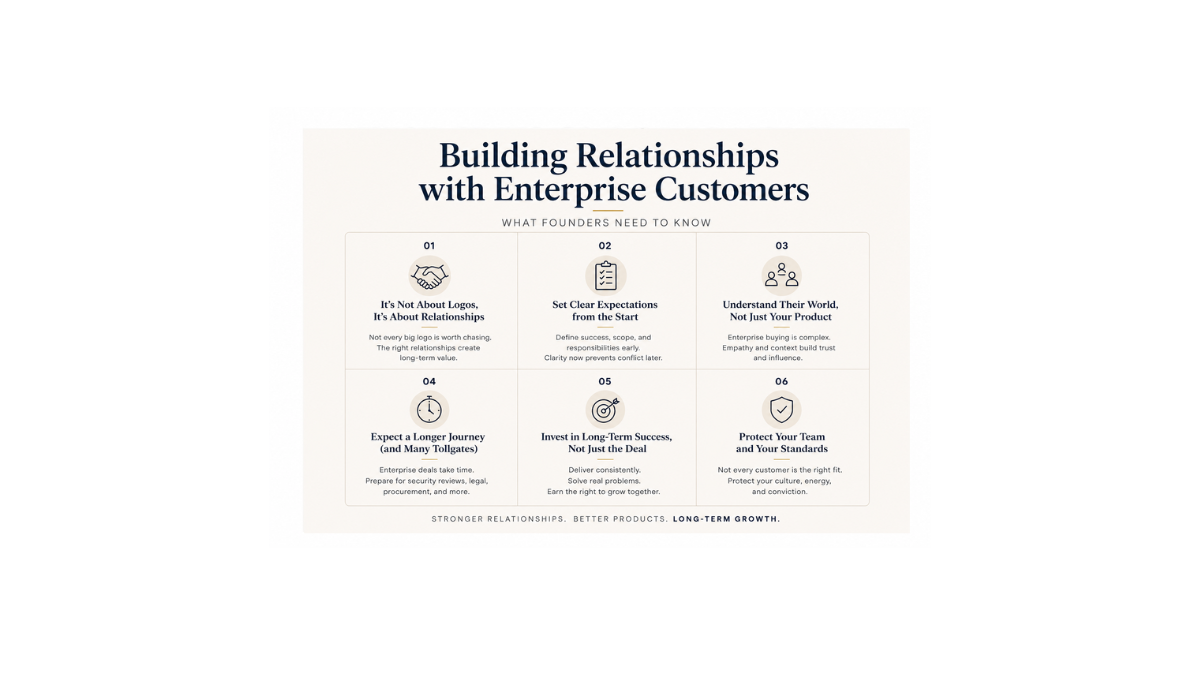
Building relationships with enterprise customers is not about collecting names. It is about choosing the right partners and managing the relationship with discipline.
Why Enterprise Relationships Feel Different
Selling to small and mid-market customers is challenging, but straightforward:
- Shorter sales cycles
- Fewer stakeholders
- Lower internal friction
Enterprise relationships are fundamentally different:
- Higher stakes
- Longer timelines
- More people involved
- Much tighter expectations around security, compliance, and performance
A single partnership can reshape your product, your internal processes, and how your team thinks about quality.
That leverage is exactly why founders need to treat enterprise relationships as strategic assets, not just revenue events.
Story 1: The Enterprise Customer That Made the Product Grow Up
One powerful example comes from a 200–300 million dollar customer that moved off a legacy event platform to work with a younger SaaS vendor.
They were running large events with 30–40k attendees and a complex program design.
They needed integrations and features the product did not yet support at that scale.
From the start, they were explicit about:
- How they defined success
- Which features were critical
- The reliability they expected
The vendor had previously supported a 100k-attendee virtual event during COVID and felt confident in their capacity.
But as the customer’s events became larger and more demanding, new challenges started appearing.
This is where the relationship mattered.
Instead of escalating immediately or threatening to leave, the customer:
- Communicated issues clearly
- Collaborated on performance testing
- Gave the vendor space to improve while still holding firm on standards
Over three years of working together, the product matured to where handling 100–200k attendees became routine.
Load testing, optimizations, and new capabilities built for this account benefited every other customer that came after.
One customer helped make the product significantly better.
This is what a healthy enterprise relationship looks like in practice:
Clarity.
High standards.
Transparency.
Mutual investment in success.
Story 2: When Foundations Are Missing
Not every challenging relationship is obviously wrong on day one.
Many broken enterprise partnerships start with good intentions:
- Positive early calls
- Apparent alignment
- Enthusiasm on both sides
The problem lies in what doesn’t get said or documented.
Common failure modes include:
- Success criteria staying vague
- No written agreement on what the product will and will not do
- Different stakeholders walking away with different expectations
Months later, this turns into conflict.
A customer believes the product should be delivering X.
The vendor is certain they committed only to Y.
Both sides feel misled.
Trust starts to disappear.
Small problems begin to feel much bigger than they really are.
In most cases, the technology isn’t the issue.
The people aren’t the issue either.
The relationship struggles because the foundation was never properly set.
Discovery was rushed.
Assumptions were left unchallenged.
Nobody forced the uncomfortable conversation about what success actually looks like.
Sometimes the fastest way to a long-term enterprise relationship is a slow, thorough beginning.
Confidence, Empathy, and Speaking the Same Language
Founders who build strong relationships with enterprise customers often talk about an internal shift rather than an external tactic.
In the early years, you show up to these meetings with:
- Minimal credibility
- Limited real-world reference points
- A lot of eagerness to please
You’re selling potential.
Over time, as you:
- Deliver for more accounts
- Live through real launches, events, and customer issues
- See similar situations repeat
You start recognizing patterns.
Combined with genuine empathy—the ability to see the situation from the customer’s perspective—you begin understanding problems before they are fully explained.
That’s when conversations change.
Instead of simply demoing features, you can say:
“Based on what you’ve described, here are the three problems we usually see and how to avoid them.”
Or:
“If success looks like this, here’s how we would approach it.”
At that point, you stop sounding like a vendor and start sounding like a partner.
The Time and Tollgates Problem
Another underestimated aspect of building relationships with enterprise customers is time.
Founders coming from SMB sales often expect:
- A few weeks of discussions
- A quick legal review
- Onboarding within a quarter
Enterprise deals rarely work like that.
It’s normal for a relationship to take 8–12 months from the first serious conversation to a signed agreement.
Sometimes longer.
Along the way, you’ll encounter multiple tollgates:
- Security questionnaires
- Technical audits
- Compliance reviews
- Legal negotiations
- Procurement approvals
- Vendor onboarding processes
Each one can slow things down if you’re not prepared.
More importantly, your behavior during these stages matters.
Do you respond clearly?
Do you take their concerns seriously?
Do you communicate delays before they become problems?
Founders who handle these phases well are remembered as reliable and mature.
Those who don’t often don’t get a second chance.
Approaching Enterprise Leaders Without Feeling Small
Enterprise leaders can seem intimidating from the outside.
In reality, they’re just people operating under a lot of pressure.
The biggest differences are:
- The number of decisions they make
- The limited time they have
- The amount of noise they deal with every day
Effective outreach is surprisingly simple:
- A concise introduction
- A clear reason for reaching out
- A specific benefit for them
- A reasonable next step
What matters more than wording is context.
A warm introduction.
A mutual connection.
Evidence that you understand their environment.
Once you’re in the room, your job is simple:
Respect their time.
Be prepared.
Offer perspectives they may not already be hearing internally.
If you consistently help them make better decisions, you stop being just another vendor.
Protecting Your Team and Your Standards
Enterprise relationships are not only about growth.
They’re also about boundaries.
Every high-stakes partnership will have moments of tension.
That’s normal.
But when a relationship consistently creates:
- Misaligned expectations
- Constant friction
- Behavior that wears down your team
It’s worth taking a step back.
Even if the revenue looks attractive.
Sometimes the right move is to reset expectations.
Sometimes the right move is to leave.
Not every enterprise customer is worth keeping.
Standing up for your standards sends a message internally:
No customer outcome justifies burning out your team.
Culture and values aren’t negotiable.
Founders who avoid these decisions often pay later through churned talent and damaged morale.
A Practical Checklist for Founders
If you’re building relationships with enterprise customers, use this checklist:
- Have we defined success in writing?
- Are we clear on what the product will not do?
- Do we understand the customer’s internal milestones and constraints?
- Are we prepared for long timelines and multiple tollgates?
- Are we maintaining credibility through consistent delivery and communication?
- Are we willing to walk away from relationships that violate our standards?
If the answer is “no” to several of these, focus there before chasing more logos.
Explore Related Insights
- Selling SaaS to Enterprise Clients
- 7 SaaS Lessons Every Founder Learns the Hard Way
Conclusion
For SaaS founders, building relationships with enterprise customers is one of the highest-leverage activities available.
The right relationships:
- Make your product better
- Sharpen your thinking
- Open doors you couldn’t have predicted
The wrong ones:
- Create confusion
- Exhaust your team
- Slow down your progress
Success in enterprise isn’t about having every large logo. It’s about choosing the relationships that make your company better over time.
— Saroosh