Every SaaS founder eventually feels the pull to “go upmarket” and sell to bigger companies.
Enterprise SaaS promises larger contracts, stronger social proof, and more predictable revenue — at least in theory.
In practice, selling SaaS to enterprise clients is messy.
The sales cycles are long, the buying process is political, and the wrong logo can quietly damage your team and your conviction.
I’ve worked with Fortune‑level organizations for years.
Some became amazing partners.
Some were so toxic that we chose to refund and walk away.
This is what I wish more founders understood before chasing “dream” logos.
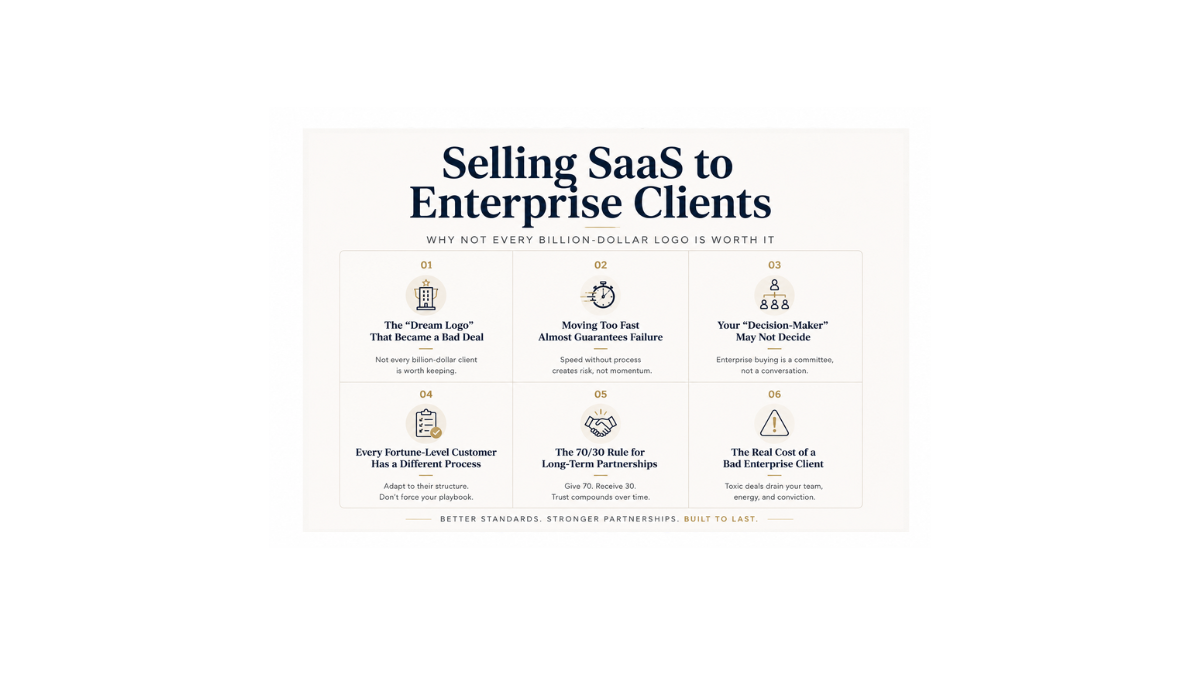
- The “dream logo” that became a bad deal
We once signed one of the largest agencies in the world.
Multi‑billion‑dollar company, global brand recognition, the kind of enterprise customer most SaaS startups would highlight on every slide.
The pre‑sales phase looked perfect:
- Senior stakeholders on calls
- Clear enthusiasm for our product
- Respectful communication
- Agreement on a meaningful scope
Then the contract was signed.
The dynamic shifted quickly:
- Timelines became completely disconnected from reality
- New requirements appeared without acknowledgment of impact
- The tone toward my support and project teams turned openly disrespectful
From the outside, nothing looked unusual: big enterprise client, tight deadlines, pressure.
From the inside, it felt very different.
We were delivering on what we promised.
We were doing the work.
But the relationship itself was unhealthy.
At that point, I had to make a choice:
- Protect the logo, or
- Protect the standards of how we let people treat our team
We chose standards.
We refunded part of the contract and ended the partnership.
That decision taught me a rule I now share with every founder:
Not every billion‑dollar client is worth keeping.
When you build an enterprise SaaS company, fit matters as much as size.
- Why moving too fast with big clients almost guarantees failure
Startup culture loves speed.
“Move fast” is useful advice in many contexts, especially in early product iterations and SMB sales.
In enterprise SaaS sales, moving too fast with a large client often does the opposite of what you want: it increases the probability of a failed implementation.
When you sell to a Fortune‑level company, you’re not just selling to one buyer.
You’re selling into a system that includes:
- Multiple business stakeholders
- Internal IT and engineering teams
- Procurement and finance
- Legal, privacy, and risk
- Security and compliance
If you try to compress all of that into an unrealistic timeline just to “impress” the client, you don’t just go faster, you start skipping steps:
- No proper risk and impact analysis
- No clear integration plan
- Incomplete security and compliance review
- Poor change‑management on their side
In the moment, it can feel like you’re being responsive and ambitious.
But when something breaks – and it will – the same people who pushed for speed will question your maturity as a vendor.
Over time, I’ve become comfortable saying:
If you move too fast with a big client, you usually don’t create momentum. You create failure.
This doesn’t mean you should be slow.
It means your enterprise SaaS sales process needs to respect the reality of how large organizations work, not the fantasy version you wish they had.
- How enterprise buying really works (and why your “decision‑maker” may not decide)
A common mistake in early enterprise sales is believing that the person you’re talking to is “the decision‑maker.”
You meet a director or VP who loves your software and you think:
“If I convince this person, the deal is done.”
That’s rarely true.
In big companies, the people you talk to early are often:
- Users or operators of the solution
- Local champions in one region or business unit
- Influencers with limited budget authority
Behind them is a buying committee that can include:
- IT and architecture
- Security and compliance
- Legal and privacy
- Finance and procurement
- Senior executives or a steering group
To make things more complex, some of your strongest champions have almost no real influence internally.
They will go to their leadership, push for you, and still get a “no.”
So if you want to improve your enterprise SaaS close rate, you need to shift your mindset:
- Your job is not just to sell to one person.
- Your job is to equip that person to sell for you inside their organization.
That means:
- Giving them a simple, credible business case they can repeat
- Preparing them for security, legal, and procurement objections
- Providing proof (case studies, ROI examples, references) that answer the questions other stakeholders will ask
Founders who ignore this reality get stuck in endless “maybe later” cycles.
Founders who embrace it build internal champions who can carry the deal over the line.
- Every Fortune‑level customer has a different “enterprise SaaS sales process”
Many articles talk about “the” enterprise SaaS sales process as if there is one universal model.
There isn’t.
From my experience, every large organization has its own version of:
- Vendor onboarding
- Security and compliance review
- Risk assessment
- Contract negotiation
- Approval workflows
Some prioritize SOC 2 and detailed audit logs.
Some care more about data residency and regulatory alignment.
Some have vendor gates driven almost entirely by procurement.
What I learned from that:
- You cannot simply copy‑paste one winning playbook into every enterprise account.
- You can develop patterns and reusable assets (security docs, ROI models, onboarding plans).
- You still have to adapt those assets to each organization’s internal structure.
Instead of asking, “How do we avoid all friction?”, ask:
- “Which friction is necessary for trust and risk management?”
- “Which friction is noise we can remove with better preparation?”
Treat friction as part of the cost of enterprise revenue, not as a bug.
- The 70/30 rule: how to build long‑term enterprise partnerships
One principle I use with Fortune‑level clients is what I call the 70/30 rule.
The idea is simple:
- I aim to give 70.
- I’m comfortable receiving 30.
This is not about letting people exploit you.
It’s about deliberately over‑delivering in ways that matter:
- Being transparent when things go right and when things go wrong
- Showing up consistently, not only around contract renewals
- Bringing ideas, optimizations, and education that are not strictly “in scope”
Why does this matter in enterprise SaaS sales?
Because large customers have options.
They can buy from your competitors.
They can attempt to build internally.
They can delay decisions and live with the status quo.
When you are the vendor that reliably gives more value than expected, especially under pressure, you become more than “a tool.”
You become part of their operating system.
Over time, this 70/30 approach compounds into:
- Deeper trust
- Access to senior stakeholders
- Smoother renewals
- Referrals into other departments and other companies
It’s not as flashy as chasing logo after logo.
But it builds something far more durable: enterprise relationships that last.
- The real cost of a “bad” enterprise customer
Most advice on selling SaaS to enterprise customers focuses on:
- How to generate leads
- How to run demos
- How to negotiate pricing
- How to close the contract
All of that is important.
What’s discussed less is the cost of selling to the wrong enterprise customers.
A misaligned Fortune‑level client can:
- Burn out your best people
- Normalize disrespectful behavior inside your company
- Force you into unhealthy product decisions
- Damage your conviction when every interaction feels like a fight
You won’t see that cost on a standard SaaS dashboard.
It shows up in turnover, tension, and how much energy you have left to build.
That’s why I’m comfortable saying:
- Some revenue is too expensive.
- Some logos are not worth what they demand.
- Walking away is sometimes the most “enterprise‑ready” decision you can make.
Final thought: Enterprise SaaS is about standards as much as strategy
If you want to sell SaaS to enterprise and Fortune‑level customers, learn the strategy:
- Understand long sales cycles and buying committees
- Prepare for security, legal, and compliance reviews
- Build internal champions and clear business cases
But don’t forget the standards:
- How should your team be treated?
- What kind of pressure is acceptable, and what is not?
- Which deals are you willing to walk away from, even if they look great on paper?
Your enterprise SaaS sales playbook should not only tell you how to win the right customers, but also how to say no to the wrong ones.
That’s how you build a company you still want to run ten years from now.
Explore related insights:
• Event ROI Framework – https://saroosh.com/how-to-measure-event-roi/
• 7 SaaS Lessons Every Founder Learns the Hard Way – https://saroosh.com/7-saas-lessons-every-founder-learns-the-hard-way/