Most SaaS advice online sounds the same:
Build a great product.
Market it well.
Close customers.
Scale.
That story makes sense on a slide. It does not match what actually happens inside real SaaS companies.
In practice, the journey looks more like this:
- Deals take far longer than expected.
- The product slowly drifts away from its original focus.
- Hiring mistakes compound.
- Tech choices quietly constrain what’s possible.
- Enterprise sales feel random and slow.
- Pivots become constant.
- The emotional cost on the founder is much higher than anticipated.
After a few years, patterns start to show up. The same mistakes repeat across different products, markets, and teams.
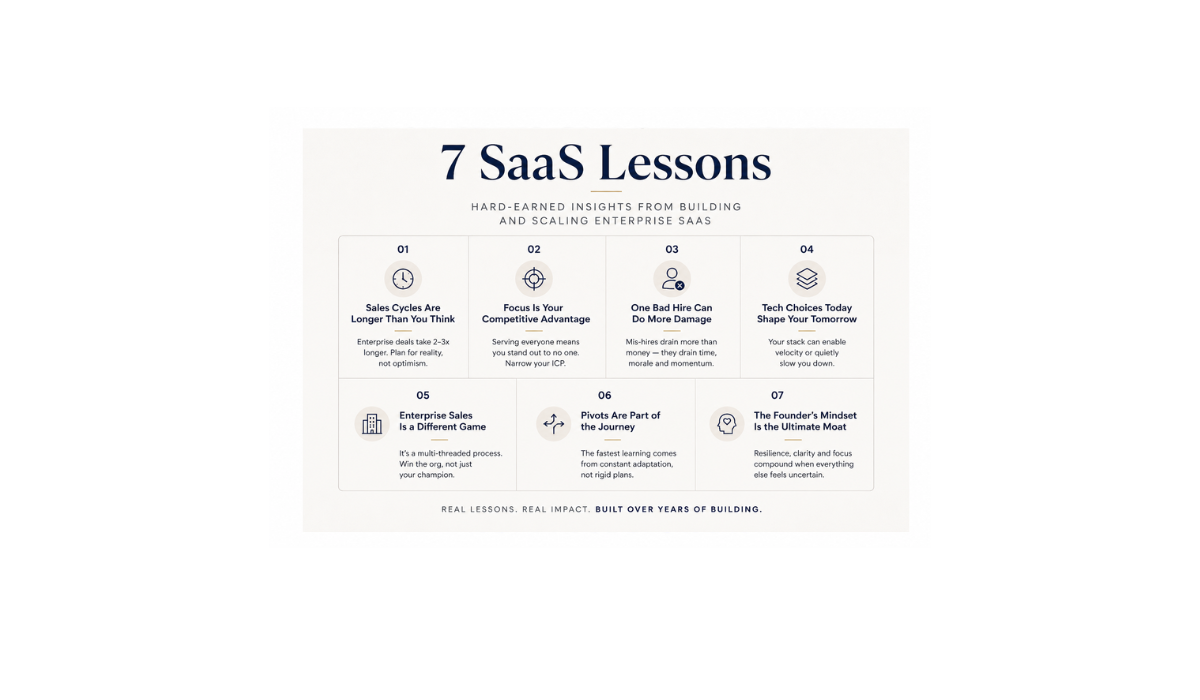
This article walks through seven SaaS lessons that keep coming up in those stories and offers practical checks you can run in your own company.
These are not abstract ideas. They come from lived experience in building and selling enterprise SaaS.
- Your SaaS sales cycle is longer than your spreadsheet thinks
Many SaaS founders underestimate how long it really takes to close enterprise deals.
On paper, a 30- to 60-day sales cycle for “serious” deals sounds achievable.
In reality, strategic contracts often take two to three times longer.
The reason is simple: an enterprise SaaS deal is not a one-to-one sale. It is a multi-layered internal process.
Behind the first enthusiastic “yes” from a champion, there is usually:
- Their manager
- Business stakeholders in other departments
- Legal
- Security/InfoSec
- Compliance/Risk
- Finance
- Procurement
- Sometimes trustees or a board
Each group brings:
- Its own review
- Its own priorities
- Its own ability to slow or stop the deal
The champion may genuinely want your solution. That does not mean the deal is close.
How to estimate a more realistic SaaS sales cycle
A practical way to avoid self-sabotaging forecasts:
- Start with your optimistic estimate for a given segment.
- Look at your actual history—what happened on similar deals in the past.
- Multiply the optimistic number by 2–3 to create a realistic range.
For example:
- Optimistic: 60 days
- Realistic: 120–180 days
Use this realistic range for:
- Revenue projections
- Pipeline reviews
- Commitments to investors and the team
Use the optimistic number only as a reference, not as the basis of your promises.
Why this matters
When sales cycles are consistently underestimated:
- Pipeline looks healthier than it is.
- Teams feel “behind” even when they’re not.
- Leadership keeps rewriting the story each quarter.
Correcting this one assumption stabilizes planning across the entire SaaS business.
- Serving “everyone” is a classic SaaS positioning mistake
Early in the SaaS journey, every new customer segment looks like an opportunity.
A new vertical shows up.
A slightly different use case appears.
A prospect offers budget for a custom feature.
Saying yes feels like growth.
Over time, those yeses compound into a product that is spread across too many directions:
- Multiple industries
- Multiple buyer personas
- Multiple primary use cases
The result is a platform that is “fine” for many people and exceptional for almost nobody.
A helpful way to visualize this is with a simple analogy:
- A plane is designed to fly.
- A car is designed to drive.
Trying to build something that acts like a plane, a car, and a boat at the same time does not produce a category-defining product. It produces a compromise that rarely dominates any category.
How to tighten SaaS focus without shrinking the opportunity
A clear ideal customer profile (ICP) is the antidote to unfocused SaaS growth.
At minimum, your ICP should answer:
- Industry/domain – Where does this product fit naturally?
- Primary buyer role – Who actually feels the pain and can move budget?
- 3 to 4 core pain points – What problems does the product solve better than anything else?
If the ICP cannot be described clearly in one short paragraph, the product is probably being pulled in too many directions.
Narrowing the ICP does not make a SaaS company smaller. It makes it sharper.
- Messaging becomes easier to write.
- Sales conversations become more consistent.
- Product decisions get clearer.
The total addressable market may look smaller on paper, but the obtainable market often grows because the product is finally built for someone specific.
- One bad hire can do more damage than a bad feature
SaaS founders often worry more about shipping imperfect features than about hiring imperfectly.
That’s backward.
A bad feature:
- Can be hidden, improved, or removed.
A bad hire:
- Affects planning, delivery, and morale every single day.
The pattern is familiar in many companies:
- The hire looks strong in interviews.
- They speak well about ownership and culture.
- Expectations are high.
Three to six months later, there are consistent signs:
- Deadlines slip without clear reasons.
- Tasks are “almost done” for too long.
- Other team members quietly pick up the slack.
The visible cost is their salary.
The deeper cost is everything around them:
- Extra work absorbed by high performers.
- Management time spent rescuing projects.
- The signal to the team that this level of performance is accepted.
Multiply that by five or ten mis-hires and an entire SaaS roadmap can drift off course.
How SaaS founders can reduce hiring damage
No hiring process is perfect, but a few practices reduce risk:
- Structured interviews with consistent questions and scoring.
- Work samples or small trial projects that mimic real work.
- Clear 60–90 day expectations documented up front.
- Regular check-ins during the first few months focused on output and behavior.
Most importantly,
When it’s clear a hire is a deep misfit, delay is expensive.
Allowing a known misfit to stay in a key role for months or years does more harm than the original hiring mistake.
Protecting the people who perform is one of the core responsibilities in a SaaS leadership role.
- Your SaaS tech stack is also a hiring and cost decision
Technical founders often choose a tech stack based on:
- Performance characteristics
- Personal familiarity
- Architectural elegance
Those factors matter. But tech stack choices also have a second dimension:
Talent and long-term cost.
Choosing a niche, low-adoption stack can create problems over time:
- A smaller pool of developers to hire from
- Longer time-to-hire for critical roles
- Higher salaries or contractor rates
- Fewer people who have solved similar problems before
This can lead to:
- Dependency on a small number of “indispensable” engineers
- Challenges when key people leave
- Slower incident response and feature delivery
In contrast, choosing a well-supported, widely used stack offers:
- Larger hiring pools
- Richer ecosystems of tools and libraries
- More peers and resources when issues arise
Questions to ask before committing to a SaaS tech stack
When evaluating or re-evaluating a stack, consider:
- How large and active is the developer community?
- How easy is it to hire mid-level and senior engineers for this stack?
- How many real-world resources and examples exist for the problems you’re likely to face?
- What do long-term maintenance and scaling look like for this stack?
The “best” technology on paper may not be the best choice if the ecosystem around it increases your operational risk.
Tech stack decisions are long-term business decisions, not just engineering preferences.
- Selling SaaS to large companies is about internal consensus, not one buyer
Selling SaaS to large organizations often feels unpredictable from the outside.
A strong champion appears.
Early conversations go well.
Then momentum slows for no obvious reason.
The underlying issue is that enterprise SaaS sales are consensus-driven, not individual.
The initial buyer or champion typically cannot sign a contract alone. They must bring others along:
- Senior leaders
- Technical stakeholders
- Security and compliance teams
- Legal
- Finance
- Procurement
Each of these groups asks a different question:
- Does this align with strategic priorities?
- Does this meet our security and regulatory requirements?
- Is the contract fair and within policy?
- Is the pricing and structure acceptable?
- Does this vendor fit our procurement standards?
Your champion may be excited about the product. But if they cannot successfully navigate this internal landscape, the deal stalls.
How to improve enterprise SaaS win rates
Treat enterprise deals as multi-threaded projects instead of single-threaded relationships.
For each strategic opportunity:
- Map the stakeholders: who influences, who decides, who can block.
- Understand what each group needs to see (value proof, security documentation and references).
- Equip your champion with clear, simple materials to present internally.
- Anticipate legal, security, and procurement requirements well before the final stage.
This does not guarantee speed, but it turns “random delays” into predictable milestones.
- Pivots are central to SaaS product–market fit, not a sign of failure
Public SaaS case studies often present a smooth narrative:
Idea → build → launch → growth.
The internal story is almost always more chaotic.
Real SaaS companies:
- Change pricing multiple times
- Remove features that nobody uses
- Add features customers keep asking for
- Narrow or expand their ideal customer profile
- Reorder or redefine their sales process
These actions are not exceptions. They are the path to product–market fit.
Micro-pivots vs. macro-pivots in SaaS
It’s useful to distinguish between:
Micro-pivots (happening weekly):
- Adjusting messaging on the website
- Removing a slide from the pitch that never lands
- Changing qualification criteria
- Tweaking onboarding flows
Macro-pivots (happening every few quarters or years):
- Focusing on a different segment
- Repositioning the product
- Changing the core packaging or pricing model
- Shifting from one primary use case to another
Healthy SaaS companies do both.
A useful operating question to ask regularly:
“What have we changed in the last 30–60 days, and why?”
If the honest answer is “not much,” it may be a sign of stagnation, not stability.
Pivots do not mean the company lacks conviction. They mean the company is listening.
- The emotional cost of being a SaaS founder is real
Most tactical content around SaaS ignores what building a company does to the people at the center of it.
Founders typically operate with:
- High ambition
- High conviction
- High personal investment
Those traits are necessary. They also increase emotional exposure.
The same mind that can see a path to a $100M product feels every negative signal strongly:
- Lost enterprise deals
- Failed hires
- Unexpected churn
- Slower-than-forecasted growth
This can create intense internal swings:
- Days when everything feels inevitable
- Days when everything feels at risk
A useful analogy is the athlete:
An athlete can be in top form, playing at an elite level.
A small injury, even a broken finger, can disrupt an entire season physically and psychologically.
Founders experience similar patterns. A single setback can reshape how everything feels, even if the fundamentals are still solid.
Staying grounded as a SaaS founder
There is no simple formula, but a few practices help:
- Recognize the swings as part of the process, not as evidence about the future.
- Avoid making major strategic decisions from emotional extremes—either euphoric or discouraged.
- Maintain a small circle where the full, unpolished version of the story can be shared.
- Use realistic planning (as in Lesson 1) to reduce self-inflicted disappointment.
Ambition and emotional volatility come as a pair. The work is not to eliminate one, but to build systems that keep decisions grounded even when feelings fluctuate.
Bringing the seven SaaS lessons together
These seven lessons do not live in isolation. They interact:
- Underestimated timelines create pressure, which leads to rushed hiring or overpromising.
- An Unclear ICP makes enterprise sales even slower and tech decisions harder.
- Bad hires magnify the pain of long cycles and complex stacks.
- Lack of pivots freezes the company in patterns that are not working.
- Founder emotional swings amplify all of the above when there are no grounding mechanisms.
A simple practical way to use these insights:
Run a “SaaS Health Check” with your leadership team
Create a one-page document with these headings:
- Timelines – Where are expectations clearly out of sync with reality?
- Focus (ICP) – Where is the product trying to serve too many different customers at once?
- Hiring – Where is there a known misfit in a key role?
- Tech Stack – Which technical choices make hiring or maintenance harder than it should be?
- Enterprise Sales – Which strategic deal lacks a clear stakeholder map?
- Pivots – What needs to change in the next 30–60 days but hasn’t started yet?
- Founder State – What decisions are being made under emotional extremes rather than after they’ve passed?
Write one sentence under each heading.
Then pick one area to act on this month.
Not all seven. One.
SaaS companies rarely fail because one big thing goes wrong.
They struggle because small, fixable issues are ignored long after they become visible.
These seven lessons are the ones that show up again and again in companies that have been at it for a few years.
The earlier they are treated as operating principles instead of postmortem insights, the better the odds of building something durable.
If you’re interested in measuring business outcomes beyond product growth, read our guide on Event ROI Measurement.
Link:
https://saroosh.com/how-to-measure-event-roi/